Ashwini Gupta, Ph.D.

Research

Our research bridges computational solid mechanics, stochastic microstructure modeling, and scientific machine learning to accelerate the analysis and design of heterogeneous and composite engineering materials.

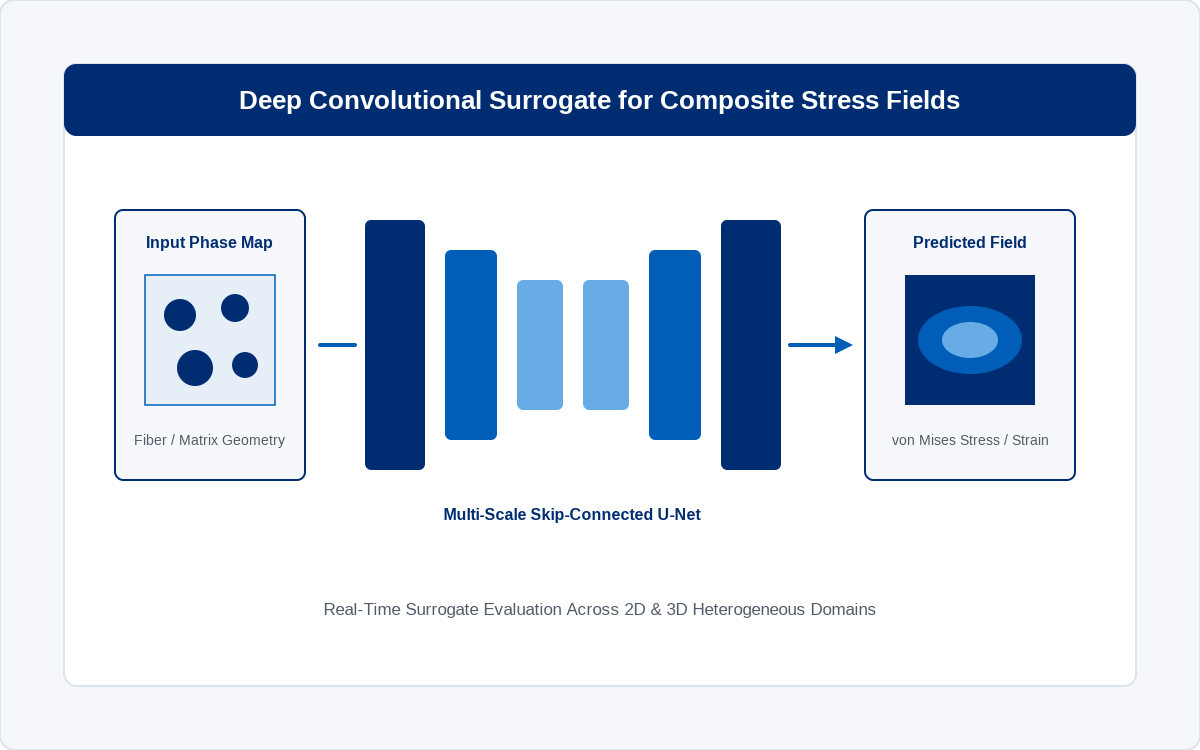
Architecture diagram illustrating a deep convolutional neural network mapping a 2D fiber-reinforced microstructure image to full-field von Mises stress contours.
Deep convolutional neural network surrogate mapping microstructural geometry directly to local stress and strain fields.

Deep Learning for Multiscale Mechanics

Physics-informed neural surrogates for full-field elasto-plastic stress and strain prediction.

Predicting localized stress and strain fields inside fiber-reinforced and two-phase composite microstructures is essential for understanding damage initiation, yet direct numerical simulation across thousands of microstructural realizations remains computationally prohibitive.

Our research formulates deep learning architectures tailored to computational solid mechanics, including:

  • Full-field stress and strain surrogates: Predicting spatial elasto-plastic response directly from binary or multi-phase microstructure representations.
  • 3D scaling and generalization: Extending neural network surrogates across varying volume fractions, spatial resolutions, and three-dimensional heterogeneous domains.
  • Accelerated multiscale coupling: Embedding trained neural surrogates within macro-scale finite element workflows to enable rapid uncertainty quantification and reliability analysis.
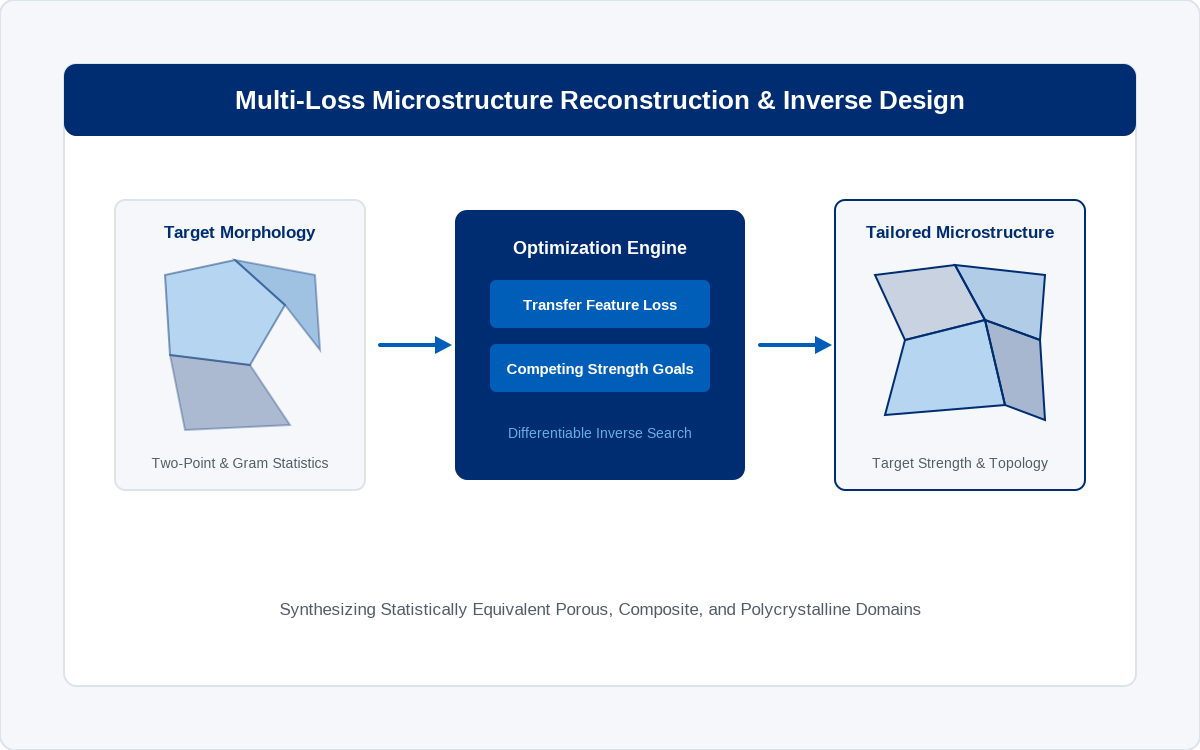
Diagram illustrating multi-loss microstructure reconstruction and inverse deep-learning optimization of polycrystalline grain topologies.
Multi-objective reconstruction and inverse design loop balancing competing strength and morphological requirements.

Stochastic Microstructure Reconstruction & Design

Optimization and transfer learning frameworks for synthesizing statistically equivalent and property-optimal materials.

Accurate digital twins of heterogeneous media require statistical reconstruction algorithms that capture both geometric descriptors and higher-order spatial correlations from limited experimental imaging.

Key thrusts in this pillar include:

  • Multi-loss optimization reconstruction: Combining two-point correlation statistics, lineal-path functions, and feature-space descriptors to reconstruct complex porous and composite media efficiently.
  • Transfer learning representations: Leveraging pre-trained convolutional feature maps to accelerate reconstruction and structure–property linkage studies on scarce microscopy datasets.
  • Inverse microstructure design: Coupling differentiable neural surrogates with optimization algorithms to tailor polycrystalline microstructures under competing strength and toughness requirements.
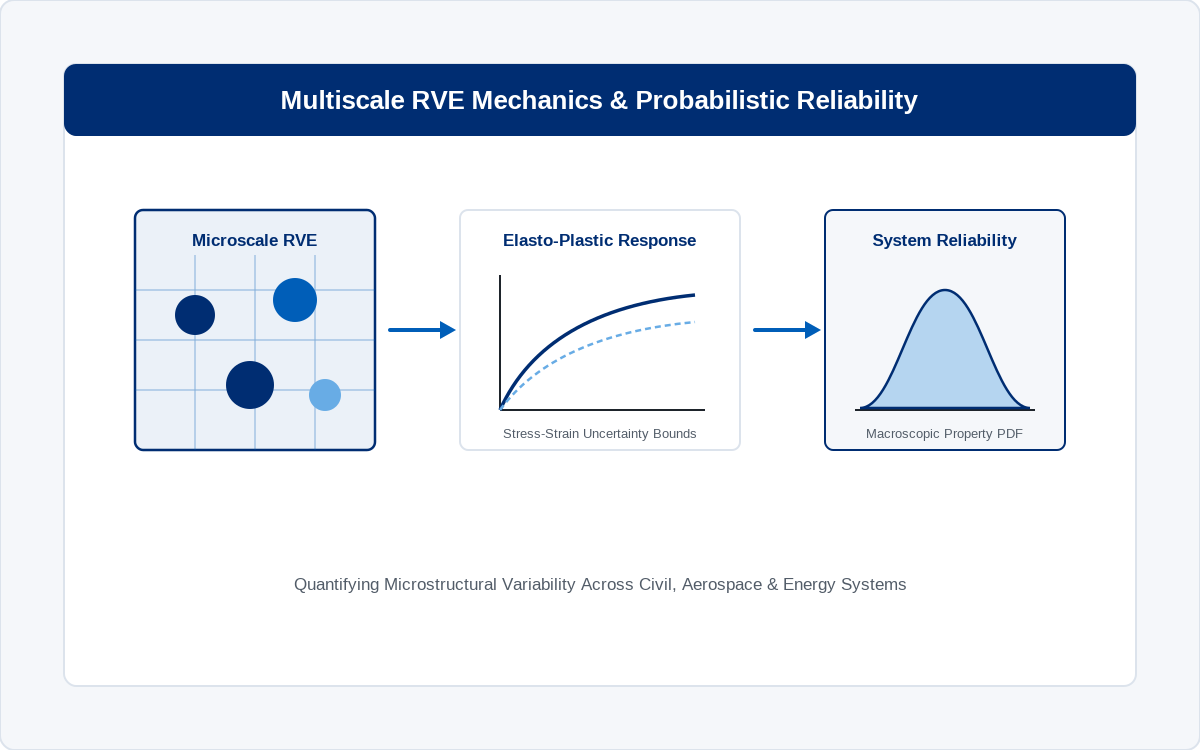
Multiscale diagram connecting a representative volume element (RVE) with fiber inclusions to macroscopic structural response and probabilistic distribution curves.
Bridging representative volume elements (RVEs) and continuum structural mechanics to quantify material variability.

Computational Mechanics of Heterogeneous Materials

Linking microstructural randomness to macroscopic nonlinear response, localization, and structural reliability.

Engineering composites, porous media, and polycrystalline alloys exhibit significant property scatter arising from inherent randomness in constituent phase geometry, orientation, and interface behavior.

Our computational mechanics efforts focus on:

  • Representative Volume Element (RVE) modeling: High-resolution finite element and micromechanics simulations under complex multi-axial and cyclic loading paths.
  • Structure–property–performance linkages: Identifying critical morphological features that govern peak local stress, plastic yielding, and damage evolution.
  • Probabilistic engineering systems: Propagating microscale uncertainty to structural-scale reliability metrics for civil, aerospace, and energy infrastructure applications.